
Maps of World War II 1939-1945
Maps of the Eastern Front 1941-45
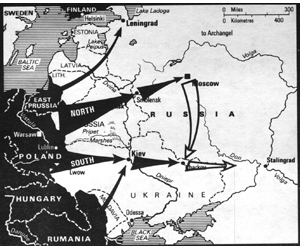
Marcks Plan
The initial German military proposal for an invasion of the Soviet Union which feature called for two army groups and primary strikes in the direction of Moscow and Kiev with a secondary attack toward Leningrad. The northern army group would push southward after reaching Moscow, linking up with the southern group at Kharkov.
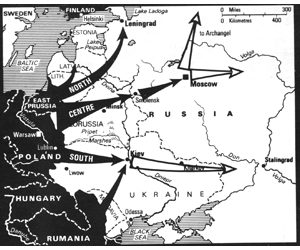
OKH Plan
The revised German Army High Command proposal for an invasion of the Soviet Union added weight to the attack toward Leningrad and called for a separate army group for this purpose. It also anticipated further eastward exploitation, independently, by the central and southern army groups.
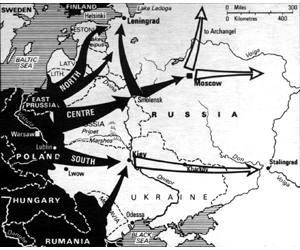
Final Plan
After consultations with Hitler, the final plan for Operation Barbarossa called for the diversion of forces from the central army group, after the capture of Smolensk, to support the northern army group in attacking Leningrad and only after achieving this would the central army group continue operations toward Moscow. The objectives of the southern army groups essentially remained the same.
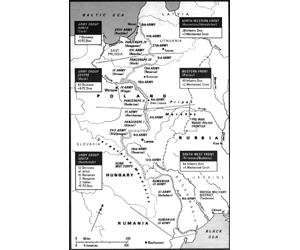
Order of Battle for Operation Barbarossa June 21, 1941
Three German army groups faced three Soviet fronts. The German forces had effective superiority at the center of the front. Soviet forces held a numerical advantage on the northern and southern flanks.
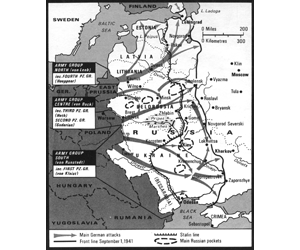
Operation Barbarossa: June 22 - September 1, 1941
German armed forces achieved strategic surprise and made substantial progress towards their initial objectives. Army Group Center reached Smolensk by July. Large Soviet military forces were surrounded as a result. An operational pause ensued at the center of the front while armored forces from Army Group Center struck south to link up with forces striking northward from Army Group South. This move destroyed a substantial concentration of Soviet armed forces around Kiev.
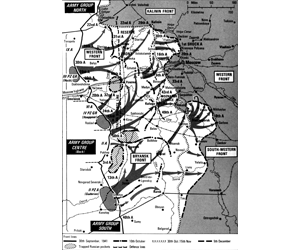
Operation Typhoon: September 30 - December 5, 1941
German armed forces regrouped in September, after the destruction of Soviet military forces around Kiev, with the intention of launching a final offensive against Moscow (Operation Typhoon) before winter. The attack began with promise but the autumn rains made it impossible to continue the operation until the winter frost arrived. By this time, German military units were exhausted and the Soviet defenders were demonstrating increasing resistance.
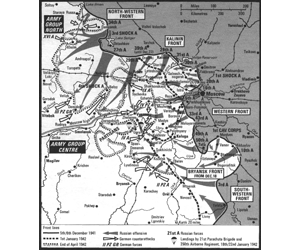
Soviet Counteroffensive: December 6, 1941 - April 30, 1942
As the German drive to capture Moscow faltered, the Soviets launched a devastating counteroffensive that created a crisis in the German military command. The depleted German armed forces were ordered by Hitler to hold at all costs and they attempted to do so. Soviet military operations expanded in scope as the counteroffensive progressed.
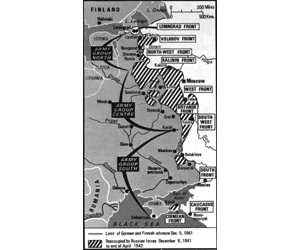
Winter 1941-42 on the Eastern Front
After the German offensive toward Moscow was called off on December 5, 1941 the Soviets launch a counter-offensive that recovered substantial territory by the end of April 1942. Soviet forces, however, did not achieve their strategic objectives and were relatively depleted by that time. German strength, meanwhile, was growing as was their confidence.
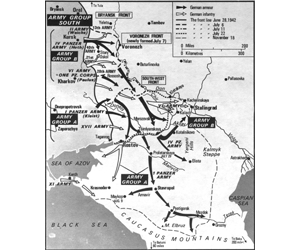
Operation Blue
The German losses sustained in the first year of warfare led to a less ambitious series of objectives being specified for the second summer campaign. Hitler's focus was on gaining control of the resources in the Caucasus. After the campaign was underway, the city of Stalingrad on the Volga became another objective. The extended left flank was eventually defended by relatively weak German allied armed forces from Romania, Hungary and Italy.
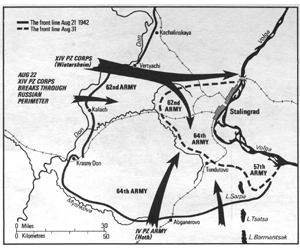
Approach to Stalingrad
By mid-August 1942, German armored forces were pressing the Soviet armies defending the front before Stalingrad into the city itself. Panzers attached to 6th Army pushed east in conjunction with 4th Panzer Army striking northward.
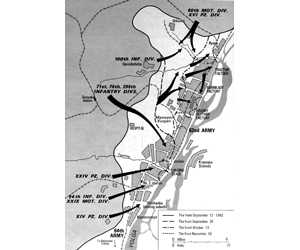
Battle of Stalingrad
As German armed forces pressed forward into the city of Stalingrad during September, they encountered increasingly effective resistance from the defending Soviet troops. Within Stalingrad, various complexes became battlegrounds
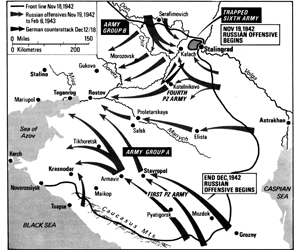
Operation Uranus: November 19, 1942 - February 6, 1943
As the German 6th Army continued its battle of attrition to capture Stalingrad, the Soviet military command prepared to launch a counteroffensive (Operation Uranus) that aimed to encircle the German army fighting in Stalingrad and bring about the collapse of southern wing of the German front.
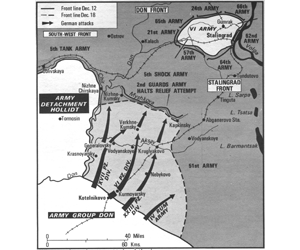
Operation Winter Storm: December 12-18, 1942
German armed forces of Army Group Don made an unsuccessful attempt break through and relieve the German 6th Army encircled in Stalingrad. Soviet military resistance proved too great to overcome with the German units available and the German 6th Army remained isolated.
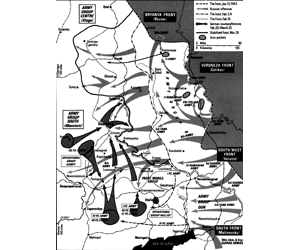
Soviet Pursuit After Stalingrad: January 13 - March 26, 1943
By the time the German 6th Army surrendered at Stalingrad, the Red Army aggressively pursued the remnants of Army Group Don, now renamed Army Group South, further west. Soviet units recaptured Kharkov and were approaching the Dniepr River. However, the commander of Army Group South, F.M. von Manstein marshaled forces for a counterattack in March 1943 that stabilized the southern wing of the Eastern Front until the Battle of Kursk in July 1943.
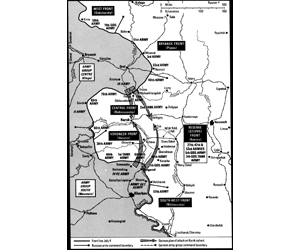
Operation Citadel: German Plan for the Kursk Offensive
The objective of the German military offensive was to pinch off the Soviet held salient centered around Kursk. Attacks from north and south were intended to encircle the region.
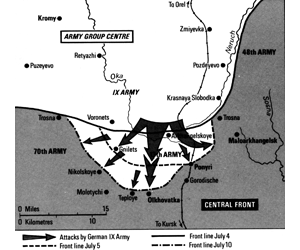
German Offensive North of Kursk: July 4-10, 1943
The German attempt to break through the Soviet defenses in the north proved ineffectual. German Ninth Army continued the effort with heavy losses against the stubborn Soviet Central Front defenses.
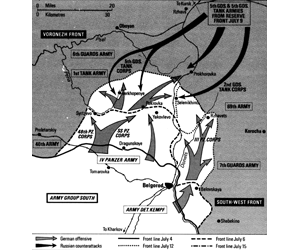
German Offensive South of Kursk: July 4-15, 1943
German Army Group South forces had somewhat greater success breaking through. Soviet military reserves were ultimately employed to halt the offensive.
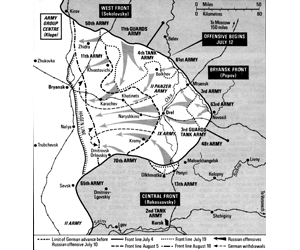
Soviet Counteroffensive in the Orel Salient:
July 10 - August 18, 1943
Soviet attacks against the Orel salient held by German Army Group Center began before the German offensive in the south was called off. German armed forces holding the salient withdrew under pressure.
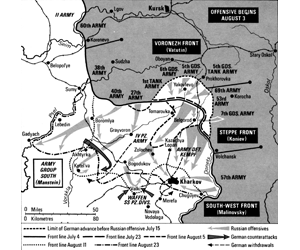
Soviet Counteroffensive South of Kursk: August 3-23, 1943
The critical situation of Soviet forces in the south delayed the launch of the counteroffensive. Resistance proved greater than around Orel and German counterattacks slowed the progress. Red Army forces recaptured Kharkov for the last time.
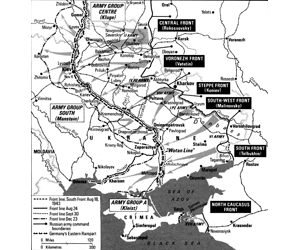
Red Army Advances to Kiev and Isolates the Crimea: August 18 - December 23, 1943
The Soviet follow-up offensive after Kursk carried the Red Army inexorably forward. Although it failed to encircle significant German forces, the Soviet armed forces trapped the German Army Group A in the Crimea and recaptured Kiev before the end of December 1943.
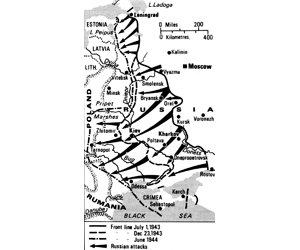
Soviet Gains on the Eastern Front: July 1, 1943 - June 1944
Red Army military forces pushed the Axis armies back to the Romanian frontier in the south leaving a massive German salient, defended by Army Group Center, before Moscow.
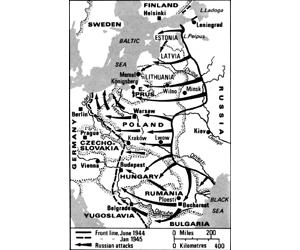
Soviet Gains on the Eastern Front: June 1944 - January 1945
The constant military pressure on the southern front led to a serious German intelligence failure in the summer of 1944. The Soviet summer offensive, opened on June 22, 1944, was directed against the Minsk salient. Army Group Center collapsed under the weight of the Red Army assault and the Soviet armed forces advanced on to the Vistula River line. The Balkans were cleared of German forces in the follow-up offensive.
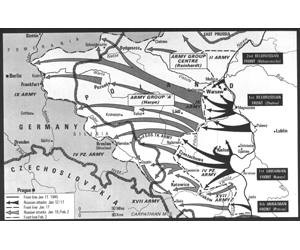
From the Vistula to the Oder: January 11 - February 2, 1945
The Soviet military offensive across Poland positioned the Red Army within the borders of prewar Germany.
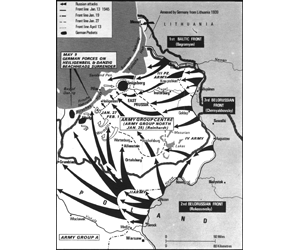
East Prussia: January 13 - May 9, 1945
Soviet attacks isolated Army Group Center (then renamed Army Group North) in East Prussia. German military resistance continued until the end of the war by which time Soviet pressure had reduced the pocket controlled by German armed forces to beachheads.
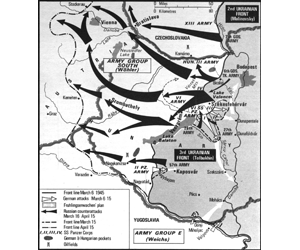
Balaton to Vienna: March 6 - April 15, 1945
The German military plan and execution of offensive operations against Soviet forces advancing beyond Budapest failed to produce lasting results. Soviet counterattacks followed and pushed the German defenders back behind Vienna.
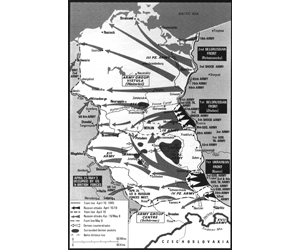
The Final Offensive: April 16 - May 8, 1945
Soviet armed forces along the Oder and Neisse built-up continuously from the completion of the conquest of Polish territory in January. The final Red Army offensive ultimately overran eastern Germany and produced a link-up between Soviet and Allied forces.
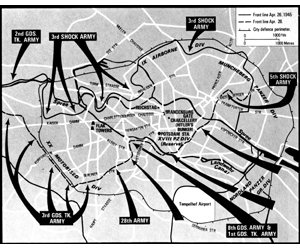
Battle of Berlin: April 26-28, 1945
Soviet armies complete the encirclement of Berlin and continued to press the attack into the city of Berlin. Most of the city was occupied within a matter of days.
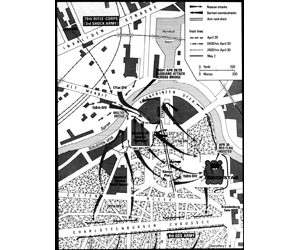
The Battle for the Reichstag: April 29 - May 2, 1945
German military resistance within Berlin continued and a prestige battle developed around the capture of the German parliament building (the Reichstag).
Copyright © 2018 Ralph Zuljan