
Maps of World War II 1939-1945
Maps of the Western Front 1944-1945
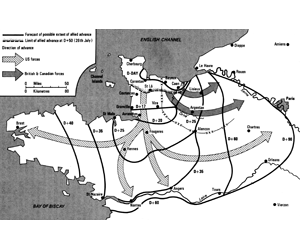
Projection of Allied Advances to July 26, 1944
Although the Allied command's expectations of progress in the first fifty days of the Normandy invasion were somewhat optimistic, the results of themilitary campaign in fact showed that the Allies had produced a reasonable forecast of progress to be expected for the first ninety days after the invasion.
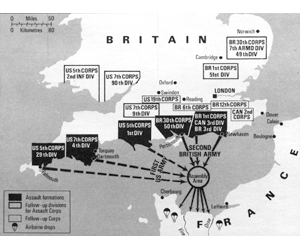
Allied Invasion Forces Available for D-Day
In addition to the armed forces that were designated for the initial landings, there were further divisions and corps allocated for exploitation after a successful beachhead was established.
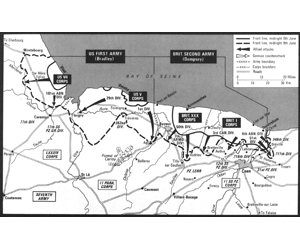
Normandy Invasion: June 6-9, 1944
The first objective after establishing the beachheads was to link the five landing sites together. German counterattacks followed the landings as well but only after an important delay.
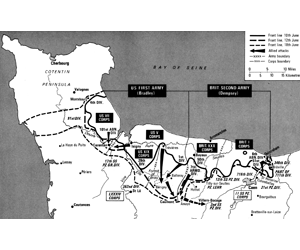
Development of the Normandy Bridgehead: June 10-18, 1944
Allied forces continued to press forward. American armed forces established a corridor cutting off the German held Contentin Peninsula while British and Canadian armies continued to tie down the bulk of the German armor in the battle for Caen.
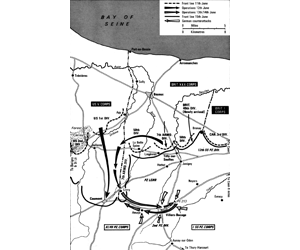
7th Armoured Division at Villers-Bocage: June 11-15, 1944
The legendary armored engagement in which a lone Tiger tank (commanded by Michael Wittmann) destroyed an entire column of British armor, took place during the 7th Armoured Division's foray into Villers-Bocage.
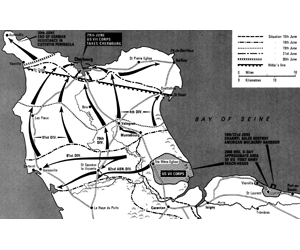
Clearing the Cotentin Peninsula: June 10-30, 1944
American armed forces initially forced a corridor across the Cotentin Peninsula and then cleared it of German military resistance by the end of June. Cherbourg was captured by June 29th and served as an important landing site and base for Allied armies operating in Normandy.
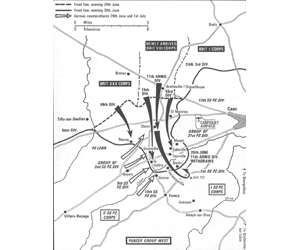
Operation Epsom: June 24 - July 1, 1944
In the continuing effort to capture Caen, British armed forces launched a flanking attack on the right of the front which proved insufficient to break the German defense. Operation Epsom, however, drew considerable German armor away from American armed forces aiming to break out of Normandy.
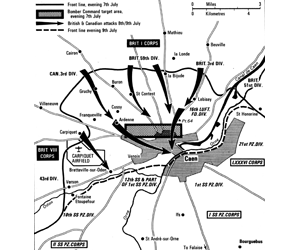
Allied Capture of Caen: July 7-9, 1944
British and Canadian military units advanced toward Caen against heavy resistance by German armed forces. Royal Air Force heavy bombers contributed to the reduction.
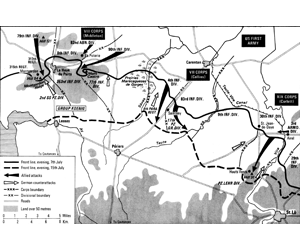
Battle of the Hedgerows: July 7-15, 1944
American military units encountered stiff resistance from German armed forces in the broken farmlands around St. Lo. Progress was slow. Costly German counterattacks continued.
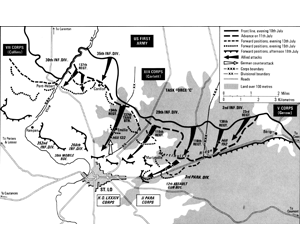
US 1st Army Advance to St. Lo July 10-18, 1944
American efforts to breakthrough to St. Lo remained slow. German armed forces put up a determined defense. The US armed forces advanced at less than one mile per day.
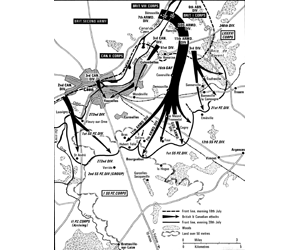
Operation Goodwood: July 18-20, 1944
British armored forces attempted to outflank Caen from the left while Canadian units continued to press forward through and and to the right. German military units, primarily of the Waffen SS, fought an aggressive defensive battle and withdrew before being trapped by Allied advances.
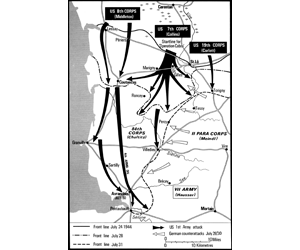
Operation Cobra: July 24-31, 1944
Benefiting from the British-led operations around Caen, American armed forces made somewhat better progress in the effort to breakout on the right flank of the Allied line. German counterattacks continued, however, and progress remained relatively slow.
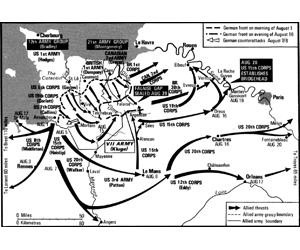
Allied Drive to the Seine: August 1-16, 1944
The successful breakout from Normandy was reflected in the Allied sweep across northern France during this period. German military resistance collapsed. Landings in southern France (Operation Dragoon) took place on August 15th and the US and French forces swept northward against light opposition.
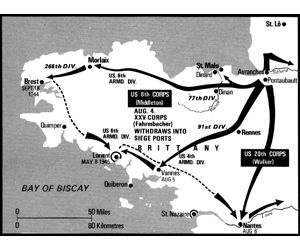
American Drive into Brittany: August 3-7, 1944
Forces of Patton's Third Army with elements of the US First Army on the left flank pressed into Brittany. The German forces fell back into designated ports to hold out, in one case up to the end of the war.
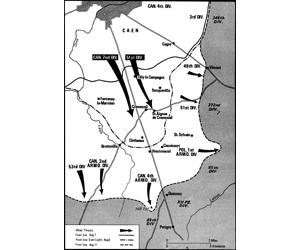
Operation Totalize: August 7-11, 1944
Canadian II Corps drove southwest from Caen in the direction of Falaise. Royal Air Force heavy bombers provided support for the effort.
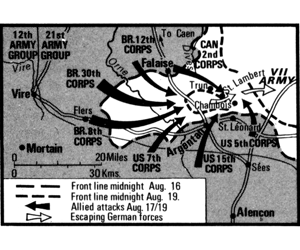
Battle of the Falaise Pocket: August 16-19, 1944
Significant military forces of the German Seventh Army were caught in the converging pincers of the Allied armies at Falaise. The relative slowness of closing the gap allowed substantial numbers of Germans to escape but only with the loss of most of their equipment. Allied fighter-bombers created havoc among the retreating Germans.
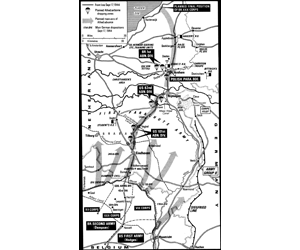
Operation Market Garden: Plan to Capture Rhine Crossings
General Montgomery's plan to capture bridges across the rivers and canals in Holland that would allow the Allied advance to continue into northern Germany, unimpeded by these natural defensive lines. German forces in Holland and especially in the Arnhem area are much stronger than anticipated. The plan proved too ambitious.
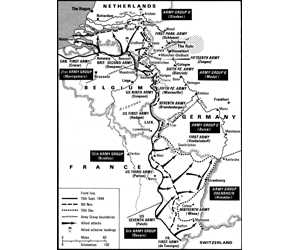
Allied Advance: September 15 - December 15, 1945
The execution of Operation Market Garden proceeded successfully at first, however, the relative strength of the German armed forces in the line of advance slowed progress. Nonetheless, in the period, Allied armed forces reached the German border, releasing all of France and Belgium from Nazi occupation.
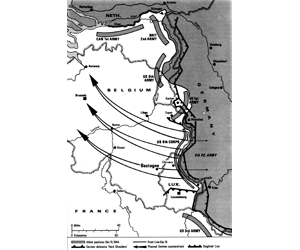
Operation Watch on the Rhine: The German Plan
Although generally acknowledged to be unrealistic, the German military intention in attacking through the Ardennes Forest to Antwerp was to cut off the northern Allied armies. The last reserves of German armored forces were secretly built up for that purpose in the area.
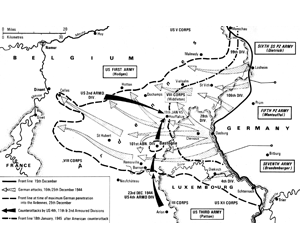
Battle of the Bulge: December 15, 1944 - January 18, 1945
German armed forces achieved strategic surprise in launching the offensive. The relatively weak American military forces blocking their advance managed to slow down the German troops sufficiently to all for an American regrouping which then effectively prevented further progress. The advantage of Allied air superiority was initially hampered by poor weather.
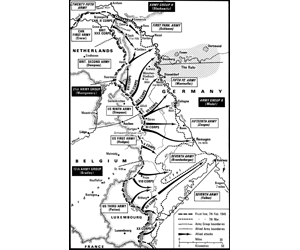
Allied Drive to the Rhine: February 7 - March 7, 1945
Following on the defeat of the German Ardennes offensive, Allied armed forces broke through towards the Rhine within the German frontier. Crossing the Rhine became the next major objective.
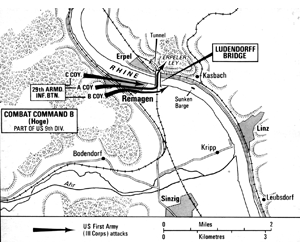
Rhine Crossing at Remagen: March 7, 1945
American armed forces achieved tactical surprise at Remagen and captured the railway bridge. The first Allied bridgehead across the Rhine was thus established.
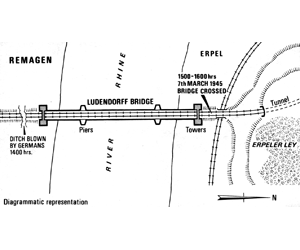
Ludendorff Bridge at Remagen: March 7, 1945
The fight for the Ludendorff Bridge across the Rhine was intensive and day-long. The bridge was weakened during the fighting and eventually collapsed. By then, a firm American bridgehead had already been established.
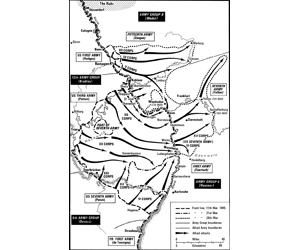
American Army Rhine Crossings: March 11-28, 1945
In the weeks following the bridge at Remagen, several other bridgeheads were established over the Rhine and these were also quickly built-up.
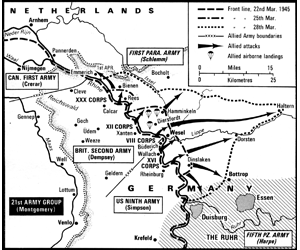
Allied Rhine Crossings, North of the Ruhr: March 22-28, 1945
Rhine crossings were also established north of the Ruhr industrial area of Germany. These served as the northern pincer of the envelopment of the Ruhr and the consequent encirclement of German Army Group B.
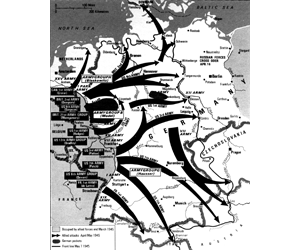
Allied Advance to the Elbe: April - May 1945
With the Rhine River obstacle overcome, Allied armed forces began a final drive which encircled Army Group B in the Ruhr valley and pressed eastward toward the Elbe River -- the agreed upon demarcation of Allied and Soviet forces advancing from west and east respectively. American military forces in the south exploited southeast into Austria and Czechoslovakia after achieving this objective.
Copyright © 2018 Ralph Zuljan